Saturday, June 4, 2016

DCC

The local model railroad club, which I joined recently, is a DCC only club. So if I wanted to bring locomotives to play on the display layouts they have to be DCC equipped.

Currently I have a pair of Bachmann GP7's that came from the factory with DCC decoders, but that was all. I decided to go ahead and convert a few. First I selected my Bachmann J class only to find out the wiring going between the tender and locomotive was shot. I have an Email to Bachmann about repairing it, but I've ordered the wiring harness in case I don't get an answer. Their customer service tends to suck a bit.

Next I decided to tackle the LifeLike SD9 that I run on my home layout. Following these instructions (with the exception of completely disassembling the shell, not necessary since it comes off in one piece) I first modified the trucks for improved pickup...which I highly recommend, if you have this locomotive...and then following these instructions (with the exception of modifying the rear weight as described in these instructions) I installed the decoder.

It was then I screwed up. I didn't test it on DC as the Digitrax instructions say to do, I just put it on the programming track and attempted to program it. The system couldn't find the decoder, all it did was blink the lights. The instructions say this is A Bad Thing, so I took the power off immediately. I then tried to run the loco on DC and the lights would just flash once when I turned the throttle up.

I tried disconnecting the motor and then the newly installed LED lights one at a time to no avail, so then I just connected the power wires to alligator clips and connected the decoder directly to the programming track. The system could still not detect the decoder, so either the decoder was bad from the factory or somehow I fried it. Fortunately Digitrax will replace it free, even if I screwed it up. Now THAT is customer service!

So then I turned to my newly acquired Model Power Pacific. It ran great on DC, so why not. Installing a decoder in a Model Power Pacific is a dead simple task as long as you aren't trying to hook the headlights up, and it only took a little time to do. The loco ran forward and backwards with no problems on an oval powered by a cheap train set power pack, so off to the programming track it went!

The programming went smoothly and soon I was happily running the locomotive around the track. The problem is it won't run on DC now. Whenever I try to run it on DC it surges; full power, down to a crawl, then back to full power. My layout DC is a PWM throttle so that may have something to do with it, but it is disappointing to say the least.

And now my best running Pacific on DC is once again the ancient Atlas.

As a side note, I also acquired a new Pennsy locomotive, a Minitrix K4.

I am disappointed to say that it runs just as poorly as Spookshow says it does (I have the one with the red gear, of course), mostly because the two drivers on the fireman's side that are wired for pickup have traction tires on them (!!! Really? You couldn't have put the traction tires on the middle drivers, neither of which are wired for pickup???), but fortunately I found some instructions to make it run better.

I have the Bachmann trucks on order (along with the J class wiring and a couple of Pennsy shells for my GP7s) and as soon as they get here I will install them and hopefully overcome it's power pick up problems. Hopefully the Motorman will return my email and tell me the good news that he has a motor upgrade kit for it as well.

So kind of a mixed bag lately railroad wise, but all in all not too bad.

Saturday, March 19, 2016

Recently

So I bought another Model Power Pacific.


I got an alert from a model RR group on the Book of Faces about a great deal through Amazon (this is the loco but it is almost 3x the price I paid for it) and since MP's operations have been taken over by MRC I thought maybe, just maybe, MRC has rectified (SWIDT?) some of their QC issues. At any rate, I thought I would give them another chance.

The loco arrived in Amazon fashion, nicely packaged and undamaged. Upon unpacking the loco I was pleasantly surprised to see a knuckle coupler on the tender, which was actually firmly attached to the locomotive. Two points ahead, and this just from opening the box, so apparently MRC has done them some good anyway.

The locomotive went on the track and much to my happy surprise ran all the way around my 11" curves without even once lifting up its front set of drivers (the other two will pop up as soon as they enter the curves). A careful examination of all three locomotives does not reveal any differences in the way they are set up, the drivers seem to move an equal amount on each one and all drivers on all locos are in gauge as measured by a MicroTrains N scale wheel gauge, so I cannot explain why the Lackawanna loco does not lift while the B&O and Chicago & Northwestern ones do.

I put all three locos on the tracks and the Lackawanna loco runs dead even with the B&O (and they both run faster than the Chicago & Northwestern), but it is a bit noisier; I can hear gear whine out of it that is not present on the other two.

After running it in for an hour (30 min frontwards and 30 min backwards, no problems) it was time to see what it would do. This is when I ran into my first issue. The McHenry coupler, which I am not really crazy about because the shank is too long, refuses to couple automatically with the MicroTrains coupler on the front of my Bachmann shorty combine. No matter what I do it will not just back in and couple, I have to twist and wiggle the car and tender to get them to couple.

Once the cars are coupled, however, the loco pulls the entire 6 car string effortlessly. I haven't tried them on my 5 car string of Rivarrosis, this would be a tougher pull since those cars do not roll as freely as the Bachmanns do, but it runs along happily just as it should.

I experimented a bit with replacing couplers and discovered that the MicroTrains Z scale coupler goes right into the pocket vacated by the McHenry, and the screw goes right into the hole as well. Unfortunately the MT Z scale coupler has to be shimmed up to mate, but once done it works great. I don't have a short shank N scale MicroTrains coupler at the moment (one is on the list for the next train shop visit) but as soon as I do I will see if it installs just as easily. For now though the McHenry will do the job.

Since Lackawanna is not one of the roads I model it is not likely that this loco will see much use on my layout for the time being, but of course this may change if I decide to paint over the green on the semi-streamlined running boards and tender. It runs so nicely it would be a shame not to use it, after all.

So in conclusion, yay for knuckle couplers and attached tenders, not so much for noise, nice running and a big YAY for not lifting the front set of drivers on the 11" radius curves. My best running Pacific is no longer an ancient out of production Atlas (although the Atlas is my second best running Pacific).

Because of this locomotive my opinion of Model Power has been upgraded from "meh to negative" to "meh to positive" and I have a feeling that the more I run it the more I will end up liking it. Well done Model Power and MRC, may your partnership continue to pay off.

Saturday, January 2, 2016

Trials and Tribulations

I finally got the DCC setup installed and working.

Installing the system was simple, I installed a DPDT switch connected to the common rail and Atlas track switch panel, connected one side of that DPDT switch to the DC controller and hooked the DCC connection panel up to the other side of the DPDT. That way the layout is either all DC or all DCC so there is no danger of running from one into the other and causing system or locomotive damage.

Second was to program my locos. I have two locomotives, a matched set of Bachmann GP7's, that are DCC equipped. I threw all the track switches except the front main to the center off position and placed the locos one at a time on the front main for programming. One of them went just fine, but the other one didn't want to run. The lights would come on when commanded, but when I pushed the throttle up the loco moved, then the lights dimmed and it slowed to a stop.

I threw the master mode switch back to DC and tried it that way with the same results. I put the first loco back on the tracks and it wouldn't move at all. I threw the master mode back to DCC and the first loco ran like a champ again. Definitely something in its programming then, a problem for another time.

I took the shell off the second locomotive...which was a chore in and of itself, those things are on TIGHT...and removed the decoder. There are two little springy contacts that supply power to the decoder, I bent them out a bit and reinstalled the decoder, and then the loco worked as it should in both DC and DCC.

On to the first loco. I tried a factory reset according to the manual but this did not solve the issue.  tried a factory reset on the second loco and then it wouldn't work on DC although it worked like a champ on DCC, just like the first one (and completely opposite of what I wanted). Off to the internets!

The issue, according to the internets, was the decoder dual mode function was set to off. The dual mode function was included in a thing called CV29, whatever that is. More digging reveals a CV is a Configuration Variable, and there is a table that shows what they all do. All very well and good, but how do I know what to set them to? More internet digging!

Fortunately the Digitrax site has some Control Variable (CV) calculators that I was able to use to determine the bit that sets the dual mode (DC/DCC) on or off. As expected, when I checked it the bit was set to off. I programmed them each for dual mode again and once more I am able to run both locos on either DC or DCC as I wish.

In my experimentation I found two of my turnouts aren't quite up to par as the locomotives short on the frogs, so I'll have to work on them a bit, but so far everything is working as it should. One thing that annoys me about this particular setup is I am apparently not allowed to run DC locomotives using the DCC controller. Not a big issue I guess since I am able to switch the master modes over, but if I had a larger layout it might become a factor.

At any rate, the NCE Powercab is working as it should and I'm having fun with it.

Wednesday, December 30, 2015

A Visit from St Nick

While I was away on vacation the following items arrived at the PVRR Corporate Office:


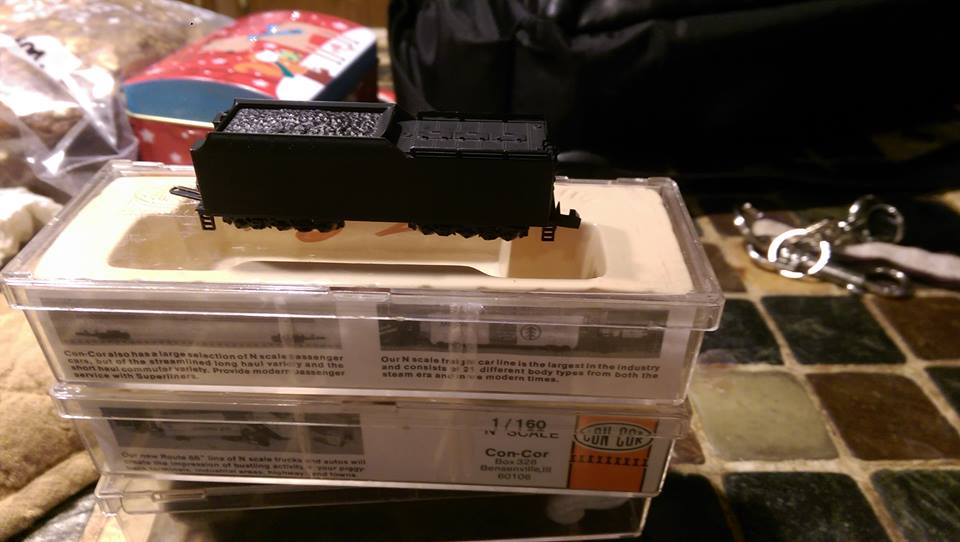
The DCC system will be installed on the Clarinda layout and one of the three long haul tenders will be used for an Erie K5A project. The other two will likely find themselves behind Atlas locomotives, most likely Pacifics as well. But first, more on the Erie K5A.

Photo from http://lists.railfan.net/erielackphoto.cgi?erielack-02-24-07/Erie_2943_Marion_9-26-49_Ron_Dukarm.jpg


This is Erie K5A number 2943. Her last engineer was a fellow named Jones, who just happens to be my wife's maternal great-grandfather. She was replaced by an Alco PA1 and Mr. Jones was the first engineer on that locomotive. I gathered this information from a couple of pictures that my wife's grandmother had and thought it might be a nice build.

The next step in the K5A project will be the procurement of a suitable JNR C57 chassis for the boxpox driver sets. I have a spare Atlas Pacific shell and various bits and pieces off of both Atlas and Model Power Pacific locomotives for what I hope will be the proper cylinders and trailing truck. The rest will be Details Associates pieces and polystyrene.

The DCC system is a new venture for me. As far as I know only two of my locomotives have decoders, a matched Bachmann GP7 set, so I am going to be learning all about DCC with them. Time will tell if I decide to stick with DCC, but since the model railroad club I am joining next month is all DCC it is likely I will be converting at least one or two steamers, too...including the K5A most likely.

I hope Santa was good to you as well.

Tuesday, November 17, 2015

Projects

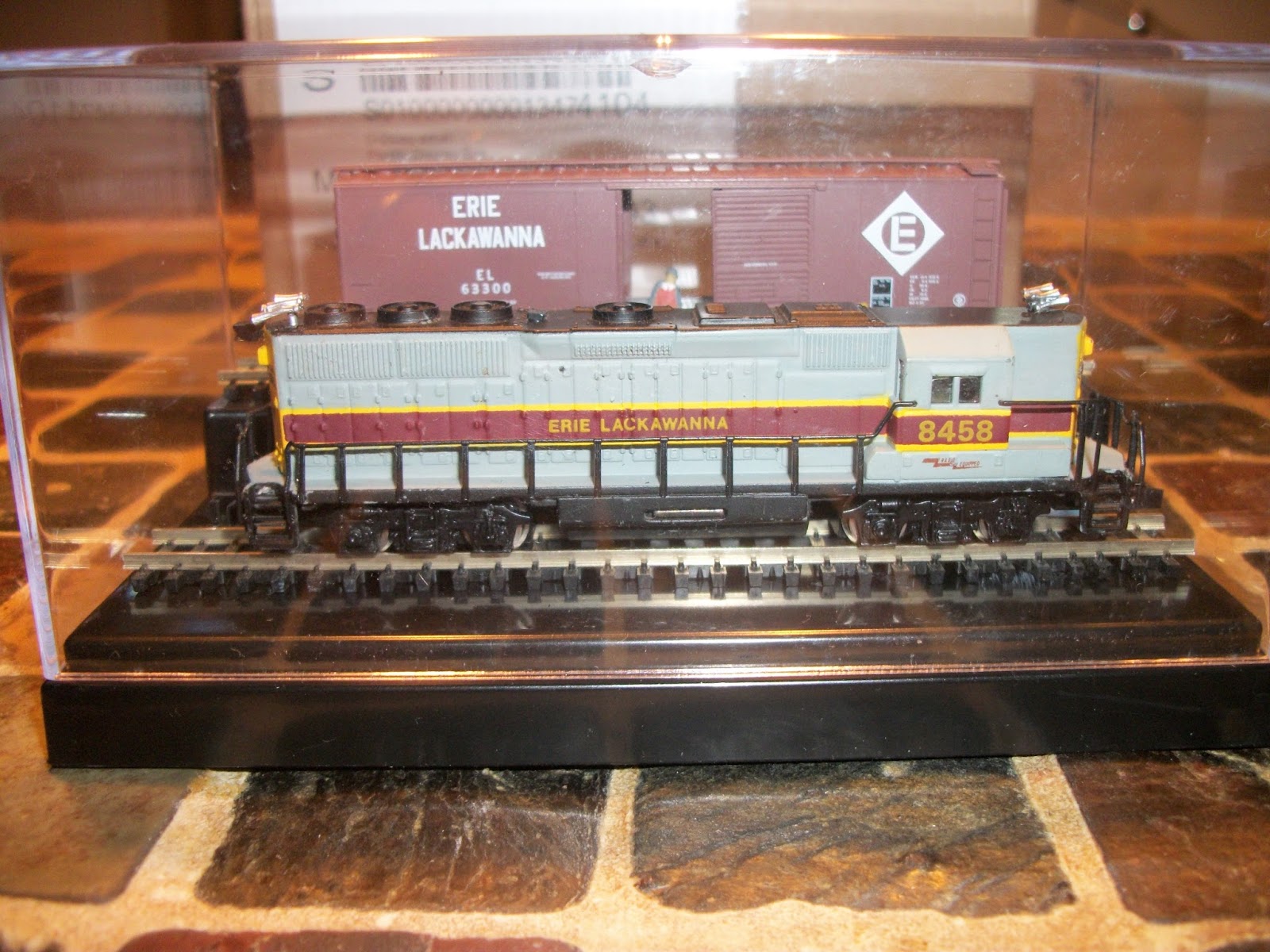
My wife's grandfather was an engineer for the Erie Lackawanna Railroad, and since I am known to be a train nut my mother in law asked me to make a little something for her to commemorate his service to that road.

My wife ventured the idea to put a boxcar in a display case, which I thought was a good one, and to that end I ordered off of Ebay the boxcar pictured below and a 4"x2" display case.


As you can see the boxcar is a 60 foot unit that scales out (60x12/160) to be about four and a half inches long, not counting the couplers. What that means is it is never going to fit in that 4 inch box.

So, back online I went to find a larger box, which I did, and at the same time I found this Bachmann SD50 locomotive for a pretty attractive price. So, I thought I would put both the locomotive and the boxcar in the new larger display case since there is going to be room for it.

Of course I did have to test-run the locomotive. It ran well with my SD7 but after one lap you could smell the motor...which is pretty typical for the old white-box Bachmann train set locomotives and kind of what I was expecting out of it anyway. So my plan is to pull the motor out of it and wire it up to a 9v battery and switch so that it can sit on the display track with the headlights on.


The new display case should be here in the next day or so and after that construction can commence. The new case has a detachable pedestal that runs the length of the box that I hope is hollow so that the battery can fit into it. If it is I will drill some holes into the locomotive frame and attach it with screws that can also be used to run the juice to it for the lights. The loco will sit on the pedestal and the boxcar will be on the base below and in front of the pedestal. The switch for the lights will be on the backside where it is not seen when the case is on a shelf.

My wife tells me I'm going way overboard for this simple project, but if it works it's going to look really cool.

UPDATE: It came out really well, and Grammy loved it.


She sent me a pic (that I didn't have saved to this computer) of it flanked by pictures of her father, one standing with his crew in front of his new PA1 and one of him in the cab of his K5A Pacific steamer. If I had seen them first I would have gotten a PA1 instead of the GP50 to put in the box, but it did give me the idea to start a new project building his Erie K5A.

Thursday, November 5, 2015

I've Been Remiss

This came in a couple of weeks ago, but I haven't yet had the time to look at it, much less build it.

I did, of course, open the box for a quick peek and it looks like it's going to be a fun build. There is enough interior to detail it if I want to and metal castings for benches and such.

Now I just need a good place on a layout to put it.

Sunday, October 18, 2015

Incoming

I just got word today that my reserved Nn3 model of Orbisonia Station has shipped. It should be here sometime next week. This has been a long-awaited project and it is likely to be a single-shot due to the general lack of interest, which is sad, but at least it did get done.

When it arrives, work schedule and personal life permitting, I will document the build.

I just hope I can do it justice.